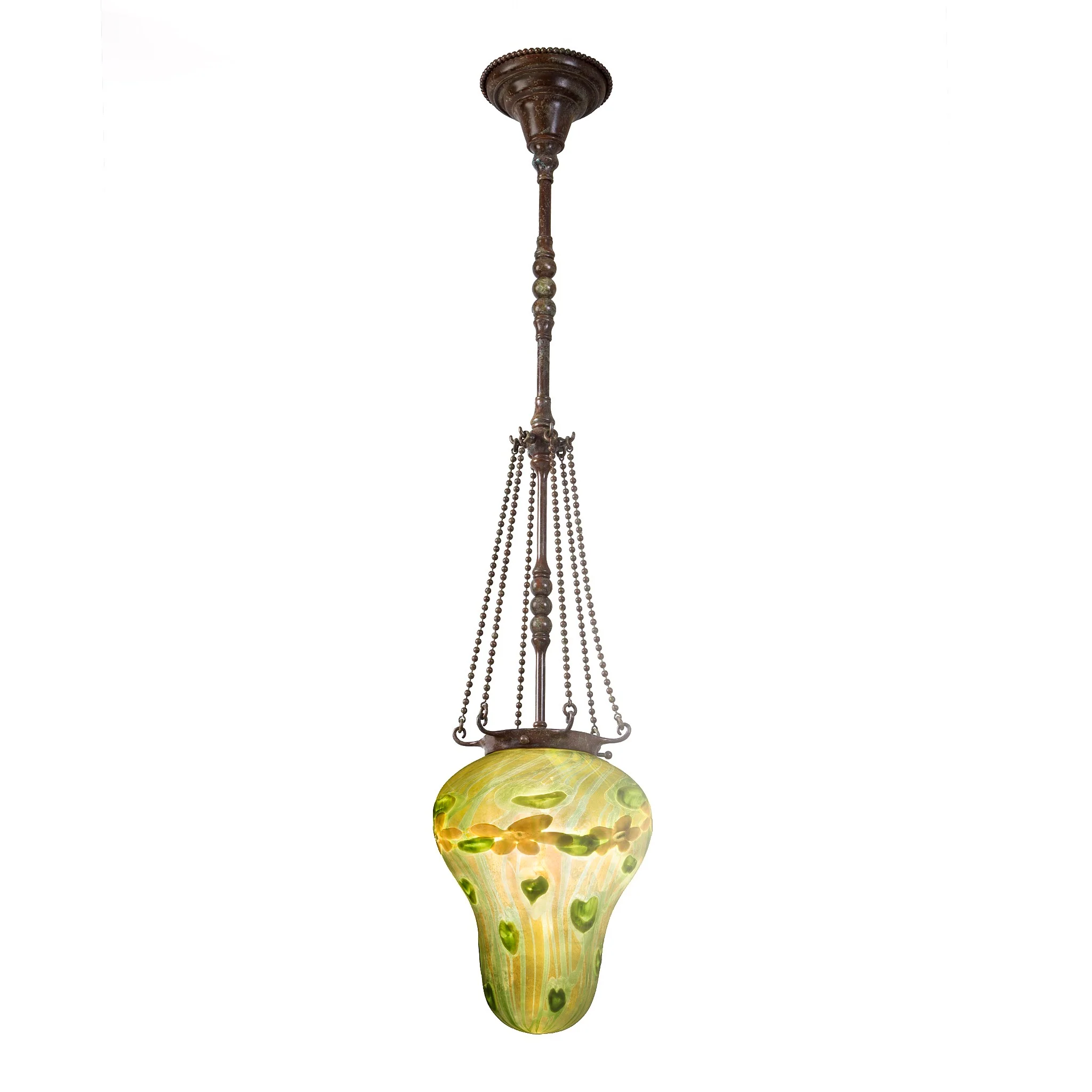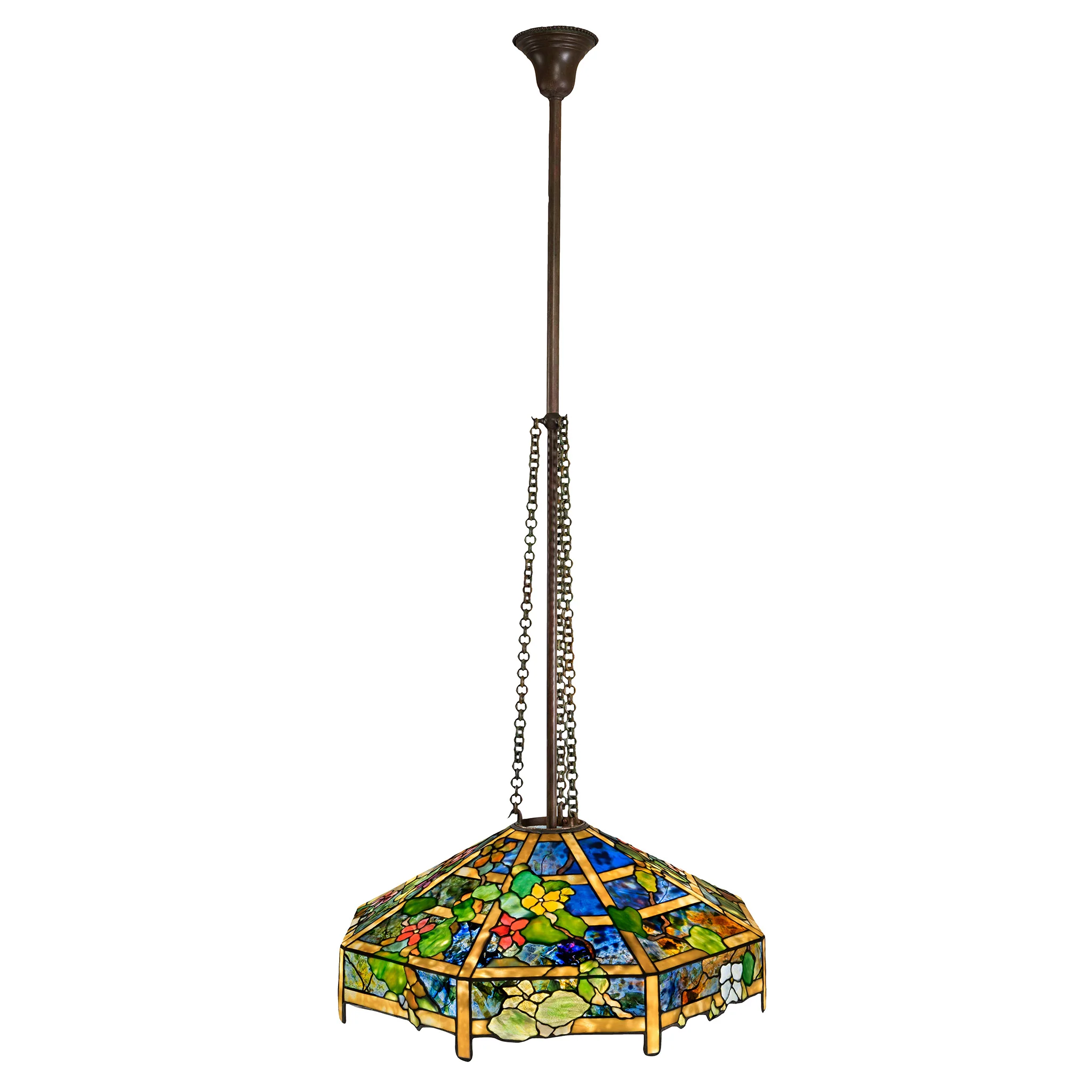
Tiffany Studios New York "October Nightshade" Chandelier
This rare eight panel Tiffany studios chandelier depicts the fruit, flowers, and leaves of bittersweet (Solanum dulcamara), a botanical cousin of deadly nightshade. Louis Comfort Tiffany found inspiration in this plant’s paradoxical nature—its vivid beauty and inherent toxicity—and designed several pieces of jewelry based on it for the 1904 World’s Fair. The bittersweet’s dual symbolism resonated deeply with the Art Nouveau era’s preoccupation with fatal beauty and the entwinement of life and death. The bittersweet plant also appears in Nathaniel Hawthorne’s gothic short story "Rappaccini’s Daughter", in which a young student visits the poisonous garden of Dr. Giacomo Rappaccini and falls in love with the doctor’s daughter, Beatrice. Having tended the toxic plants since childhood, Beatrice herself has become poisonous. The student is captivated by a plant “that bore a profusion of purple blossoms, each of which had the lustre and richness of a gem… enough to illuminate the garden, even had there been no sunshine.” The plant comes to symbolize Beatrice and the inevitability of the lovers’ tragic fate. In much the same way, the chandelier’s depiction of bittersweet becomes a visual metaphor for beauty laced with danger. Like Beatrice, it is both enchanting and unsettling—a luminous embodiment of Art Nouveau’s fascination with nature’s seductive, perilous dualities.
More Images








Tiffany Studios New York "October Nightshade" Chandelier
This rare eight panel Tiffany studios chandelier depicts the fruit, flowers, and leaves of bittersweet (Solanum dulcamara), a botanical cousin of deadly nightshade. Louis Comfort Tiffany found inspiration in this plant’s paradoxical nature—its vivid beauty and inherent toxicity—and designed several pieces of jewelry based on it for the 1904 World’s Fair. The bittersweet’s dual symbolism resonated deeply with the Art Nouveau era’s preoccupation with fatal beauty and the entwinement of life and death. The bittersweet plant also appears in Nathaniel Hawthorne’s gothic short story "Rappaccini’s Daughter", in which a young student visits the poisonous garden of Dr. Giacomo Rappaccini and falls in love with the doctor’s daughter, Beatrice. Having tended the toxic plants since childhood, Beatrice herself has become poisonous. The student is captivated by a plant “that bore a profusion of purple blossoms, each of which had the lustre and richness of a gem… enough to illuminate the garden, even had there been no sunshine.” The plant comes to symbolize Beatrice and the inevitability of the lovers’ tragic fate. In much the same way, the chandelier’s depiction of bittersweet becomes a visual metaphor for beauty laced with danger. Like Beatrice, it is both enchanting and unsettling—a luminous embodiment of Art Nouveau’s fascination with nature’s seductive, perilous dualities.
Product Information
Product Information
Shipping & Returns
Shipping & Returns
Description
This rare eight panel Tiffany studios chandelier depicts the fruit, flowers, and leaves of bittersweet (Solanum dulcamara), a botanical cousin of deadly nightshade. Louis Comfort Tiffany found inspiration in this plant’s paradoxical nature—its vivid beauty and inherent toxicity—and designed several pieces of jewelry based on it for the 1904 World’s Fair. The bittersweet’s dual symbolism resonated deeply with the Art Nouveau era’s preoccupation with fatal beauty and the entwinement of life and death. The bittersweet plant also appears in Nathaniel Hawthorne’s gothic short story "Rappaccini’s Daughter", in which a young student visits the poisonous garden of Dr. Giacomo Rappaccini and falls in love with the doctor’s daughter, Beatrice. Having tended the toxic plants since childhood, Beatrice herself has become poisonous. The student is captivated by a plant “that bore a profusion of purple blossoms, each of which had the lustre and richness of a gem… enough to illuminate the garden, even had there been no sunshine.” The plant comes to symbolize Beatrice and the inevitability of the lovers’ tragic fate. In much the same way, the chandelier’s depiction of bittersweet becomes a visual metaphor for beauty laced with danger. Like Beatrice, it is both enchanting and unsettling—a luminous embodiment of Art Nouveau’s fascination with nature’s seductive, perilous dualities.