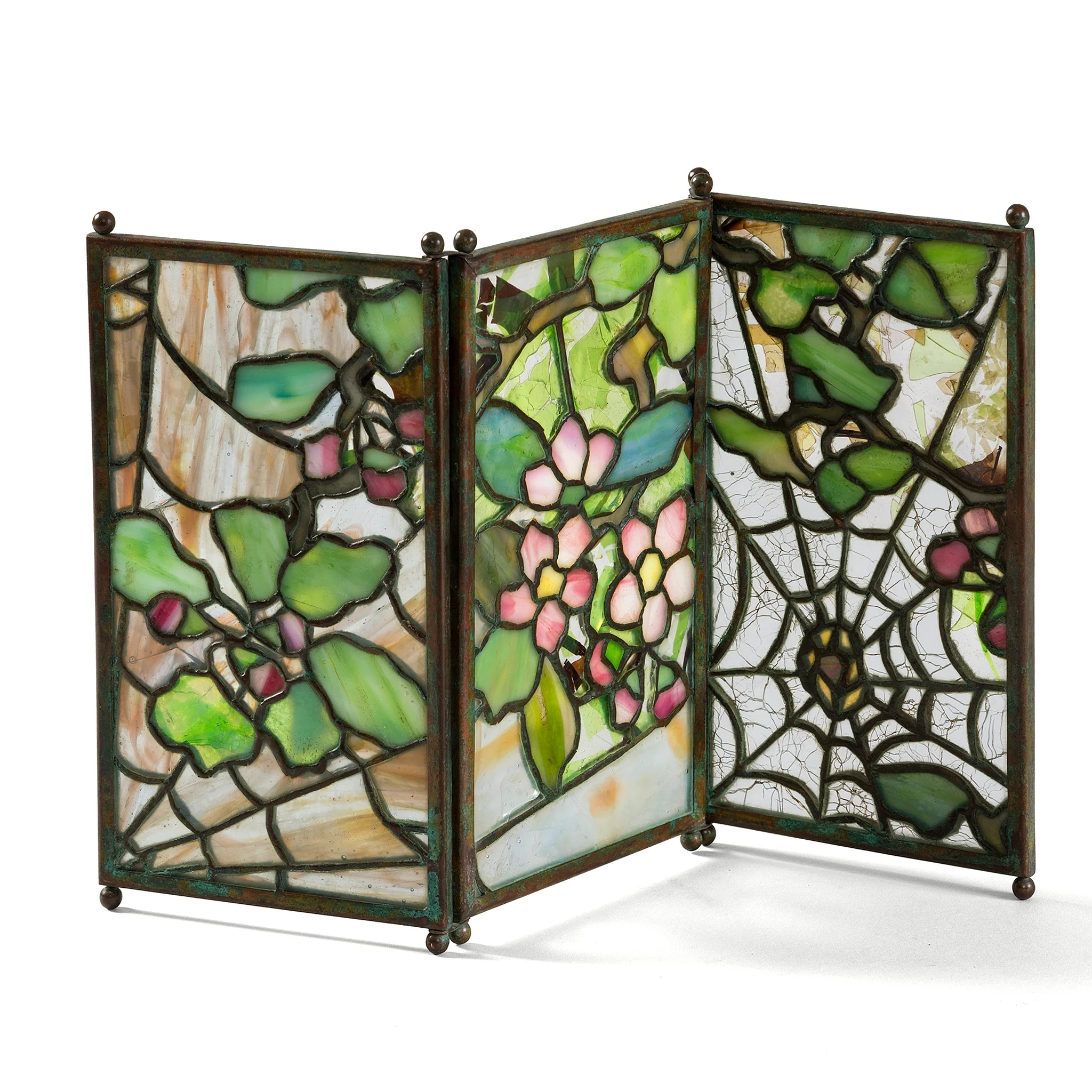
Tiffany Studios New York "Cobweb and Apple Blossom" Tea Screen
Tiffany Studios was renowned for transforming everyday household objects into works of art. This tea screen, while functional in shielding the flame beneath a teapot, was conceived primarily as an ornamental piece, inspired by the byōbu, or traditional Japanese folding screen. It represents a rare and exquisite variation of Tiffany’s most expensive lamp—the Apple and Cobweb—designed prior to 1902.
The cobweb motif held a long-standing place in Tiffany’s design repertoire, first appearing in 1881 in a series of textile and wallpaper patterns created for the Mark Twain House. For that commission, Tiffany collaborated with Candace Wheeler to produce a suite of “Japanesque” textiles featuring clematis vines, seedpods, and honeybees caught in intricate webs. The design itself was rooted in an 18th-century Japanese pattern of maple leaves entangled in spider webs—a theme later reinterpreted by the artist Katsushika Hokusai in One Hundred Views of Mount Fuji, where the mountain is seen through a spider’s web.
$42,196.29
Tiffany Studios New York "Cobweb and Apple Blossom" Tea Screen—
$42,196.29
More Images
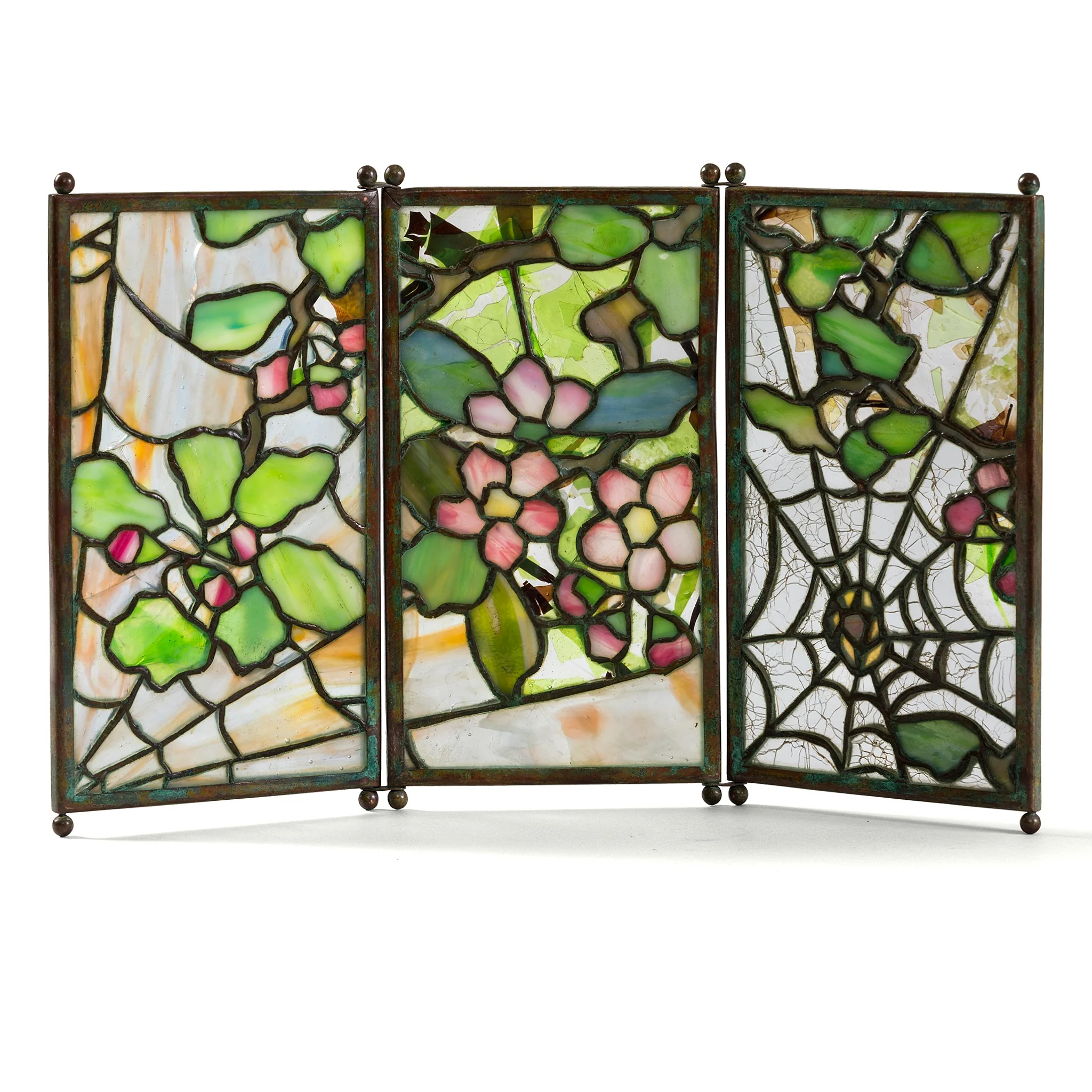


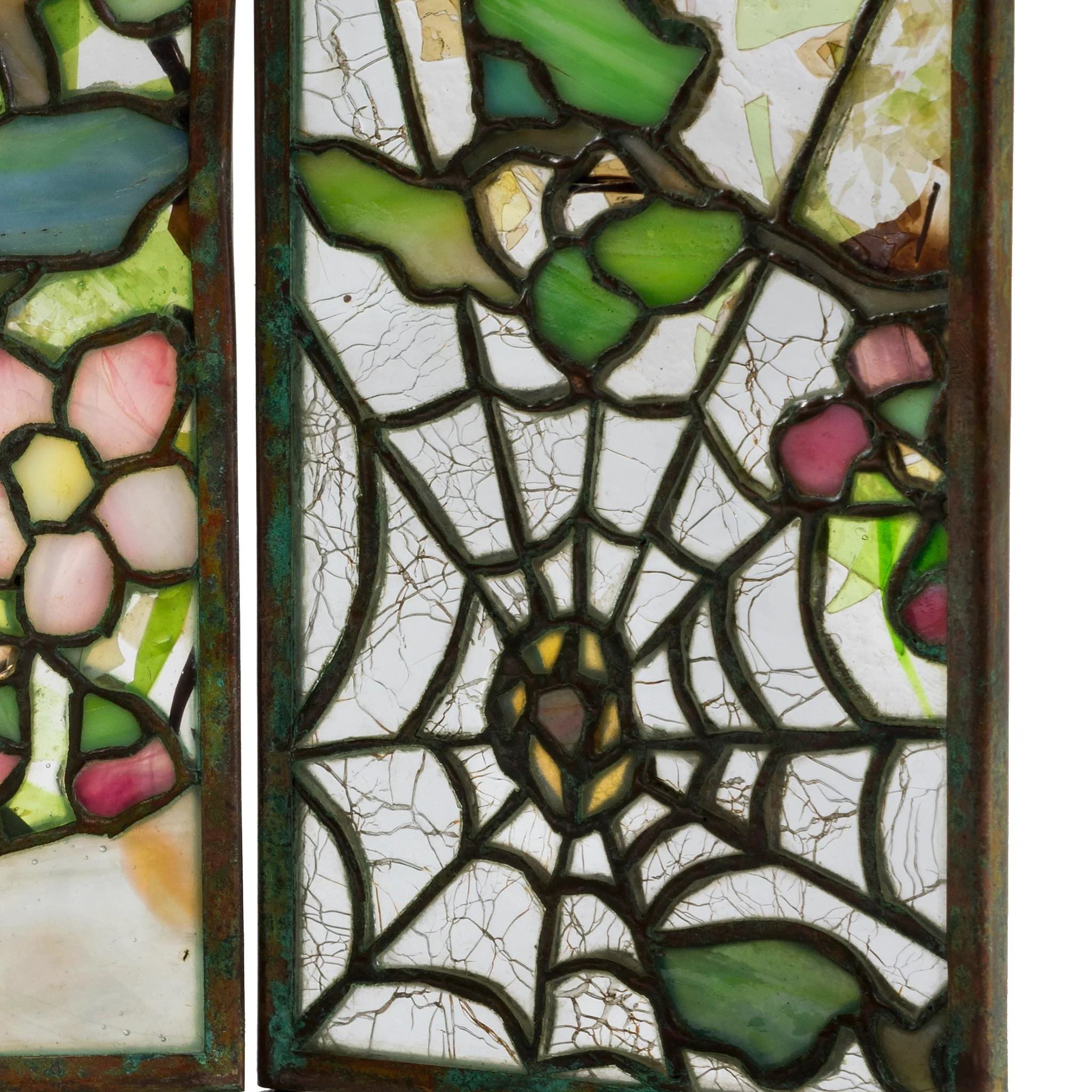
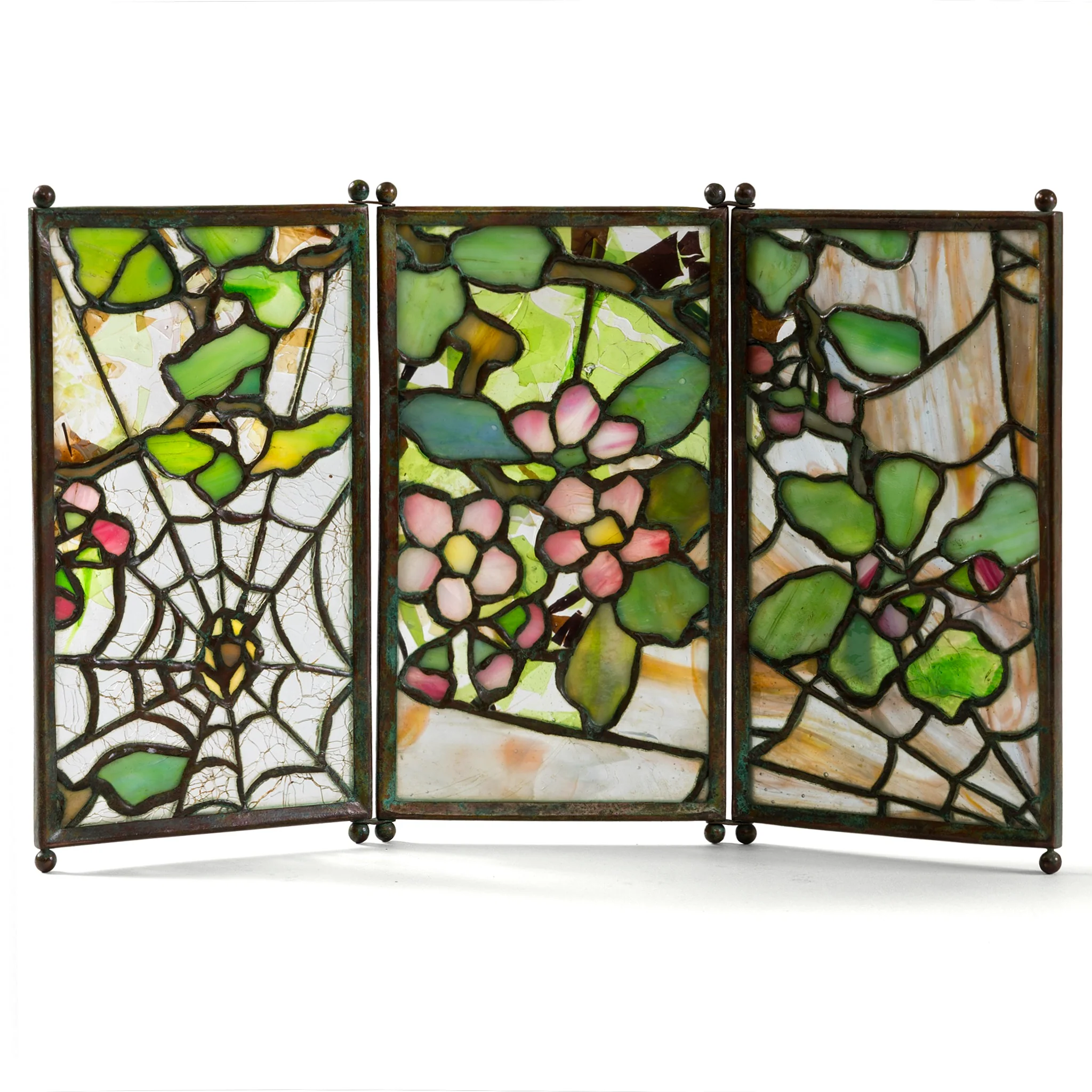
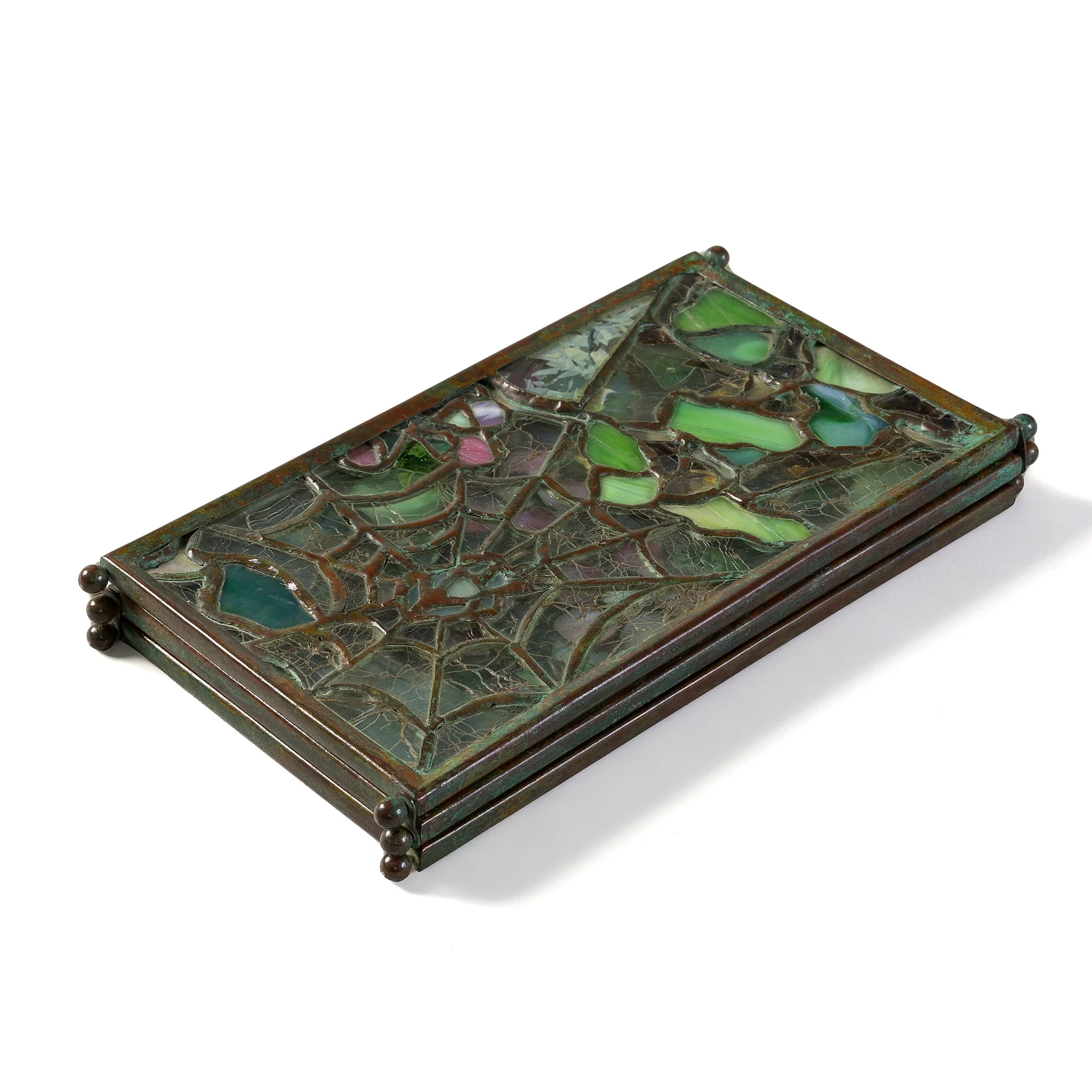
Tiffany Studios New York "Cobweb and Apple Blossom" Tea Screen
Tiffany Studios was renowned for transforming everyday household objects into works of art. This tea screen, while functional in shielding the flame beneath a teapot, was conceived primarily as an ornamental piece, inspired by the byōbu, or traditional Japanese folding screen. It represents a rare and exquisite variation of Tiffany’s most expensive lamp—the Apple and Cobweb—designed prior to 1902.
The cobweb motif held a long-standing place in Tiffany’s design repertoire, first appearing in 1881 in a series of textile and wallpaper patterns created for the Mark Twain House. For that commission, Tiffany collaborated with Candace Wheeler to produce a suite of “Japanesque” textiles featuring clematis vines, seedpods, and honeybees caught in intricate webs. The design itself was rooted in an 18th-century Japanese pattern of maple leaves entangled in spider webs—a theme later reinterpreted by the artist Katsushika Hokusai in One Hundred Views of Mount Fuji, where the mountain is seen through a spider’s web.
Product Information
Product Information
Shipping & Returns
Shipping & Returns
Description
Tiffany Studios was renowned for transforming everyday household objects into works of art. This tea screen, while functional in shielding the flame beneath a teapot, was conceived primarily as an ornamental piece, inspired by the byōbu, or traditional Japanese folding screen. It represents a rare and exquisite variation of Tiffany’s most expensive lamp—the Apple and Cobweb—designed prior to 1902.
The cobweb motif held a long-standing place in Tiffany’s design repertoire, first appearing in 1881 in a series of textile and wallpaper patterns created for the Mark Twain House. For that commission, Tiffany collaborated with Candace Wheeler to produce a suite of “Japanesque” textiles featuring clematis vines, seedpods, and honeybees caught in intricate webs. The design itself was rooted in an 18th-century Japanese pattern of maple leaves entangled in spider webs—a theme later reinterpreted by the artist Katsushika Hokusai in One Hundred Views of Mount Fuji, where the mountain is seen through a spider’s web.